
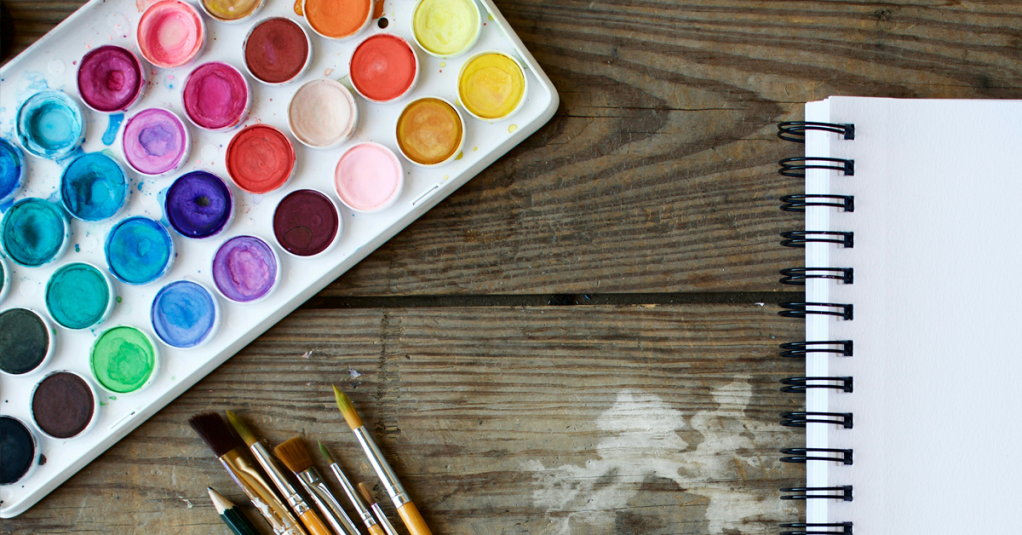
From watercolors to collage and everything in between, choosing what art medium you use to express yourself can be an exciting exploration.
Art therapy is all about self-expression and self-discovery and while all of us have a creative spark, you don’t need to be an artist to access the benefits of an art activity focused on mindfulness and mental or emotional wellness. In a guided art exercise, your facilitator may have some guidance on what art materials you use, other times the choice may be completely up to you.
Considerations for Art Therapy Mediums
When choosing what art medium you would like to use, there are several considerations to keep in mind:
- Availability. This is a very practical consideration! If you already have art supplies, you may wish to use what is on-hand. Otherwise, you’ll need to purchase materials. Depending on your location and circumstances, some art materials may be tricky to find or expensive.
- Familiarity. If you have created art in the past, even as part of your childhood education, you may be familiar with and comfortable using some art mediums already. Most people have some experience with colored pencils, crayons, and markers for example. You may also just really love a medium in particular and gravitate toward using it.
- The goal of the exercise. For guided art activities, your facilitator may give you guidance on what medium to use based on the exercise itself and the goal of your session. For instance, if the goal of the session is to reduce stress, an exercise that involves a lot of precise paper cutting with an Xacto or precision knife may not be the best choice! If the goal of the session is to connect with your inner child, finger paints or crayons may be a great choice.
- Sensory experience. If you have strong sensory needs or preferences that’s something to consider when selecting an art medium to use. Squishy, messy paint or the scratch of an ink nib can make some people’s skin crawl, for example. On the other side of the spectrum, some people can really love the glide of oil pastels, or the deep pressure of working with clay. These sensory experiences also come into play when your art therapy practitioner makes medium suggestions.
Open communication before, during, and after your guided art activity, so feel free to share your preferences and thoughts with your facilitator.
Types of Art Therapy Mediums
The sky’s the limit when it comes to creative self-expression, but there are some common art mediums that are used in art therapy and mindfulness exercises. Here are some popular options:
- Graphite. These include your trusty number two pencil, but graphite also comes a range of hardness and softness. There’s also graphite sticks, without the wood of a pencil. There’s also mechanical and drafting pencils.
- Color pencils. Colored pencils come in hundreds of colors, and can be wax-based, oil-based or water-soluble. Colored pencil sets can range 12 to 120 colors or more.
- Markers. Classic markers are water-soluble and also come in hundreds of colors, in sets of 8 to more than 300! There are also alcohol-based markers, paint markers, chalk markers, washable markers and permanent markers. Many markers also have multiple tip shapes, such as chisel or bullet, and thickness.
- Ink. Ink comes in a huge variety of colors and is widely available in pen form, including gel pens which can come in fun sparkly varieties. Ink can also be free flowing and used with brushes, be used with brushes, stylus with nibs, and refillable cartridges.
- Charcoal. Charcoal can come in different shapes and thicknesses, including compressed and rectangular, soft and cylindrical, or in pencil format. Charcoal art sometimes uses different smudging tools, erasers, and conte crayons or pastels.
- Pastels. Soft pastels might remind you of chalk, but these sticks of compressed pigments have wonderfully intense colors. Unlike soft pastels, oil pastels are made with oil and wax giving them a smooth paint-like texture instead of a powdery one.
- Paint. There are many varieties of paint, but the most commonly used in art therapy are watercolor, acrylic, and tempera. Watercolors are mostly transparent and have a very organic, dreamy-like quality, whereas acrylic paint is glossy and precise. Tempera paint is quick drying and is often used for finger painting.
- Sculpting materials. The most readily accessible sculpting material is polymer clay, which is moldable and carvable and can be air dried or fired. Soft, foam or cloud clay is easier to mold, while stone and wood require special tools and safety precautions.
- Collage. The most popular form of collage uses paper from various sources, but it can also include other art materials and found objects.
There are even more options for art mediums like: Fiber (think fabric, thread, and yarn), Printmaking (like stamping, linocut, and screenprinting), as well as photography and digital art. Artistic self-expression can be an endless, exciting exploration.
Start Exploring with WILDKEPT
Get started exploring the transformational potential of self-expression with WILDKEPT! A facilitated art activity can help you develop self-awareness, gain deeper insight into your thoughts, feelings, and experiences, reduce stress, and further your personal development. Learn more about how you can schedule a one-on-one session, attend a group session, or try a self-guided activity.

